Buying guide
Best Portable Power Stations for Refrigerators During a Power Outage
Keep your fridge cold through an outage. Compare power stations by capacity, output, and surge, and estimate runtime from your fridge's EnergyGuide label.
By the SemperPrep team · Updated 2026-11-19 · Based on manufacturer specifications and editorial analysis
SemperPrep may earn a commission when you buy through links on this site. It costs you nothing extra. As an Amazon Associate, I earn from qualifying purchases. How we make money
For a typical full-size refrigerator rated at about 500 kWh a year, a 1,000 Wh portable power station has enough stored energy for roughly 15 hours and a 2,000 Wh station for roughly 30 hours. Those are calculated estimates, not test results or guarantees, and real runtime is usually shorter. Two checks decide whether a power station suits your refrigerator: its stored energy (Wh), which sets how long the fridge can run, and its rated and surge output (W), which must handle the compressor starting. This guide shows you how to run both checks for your own refrigerator, then compares three power stations from our catalog that fit the job.
Our picks at a glance
- 1
Best overall for a full day of fridge backup
Anker SOLIX C2000 Gen 22,048 Wh · 2,400 W rated output
- About a full day for a typical fridge, expandable to 4 kWh
- 41.7 lb; Anker's documents we read do not state the AC waveform, and its 4,000 W peak figure is not explained in the manual
- 2
Best for overnight outages
EcoFlow DELTA 3 Plus1,024 Wh · 1,800 W rated output
- Overnight coverage now, expandable to 5 kWh later
- About 15 hours for a typical fridge, so not a full day without an extra battery or recharging
- 3
Best 2 kWh option without add-on batteries
Jackery Explorer 2000 v22,042 Wh · 2,200 W rated output
- About 30 hours for a typical fridge in one 39.5 lb unit
- Not expandable; 400 W solar input max; idle draw not stated
How much power does a refrigerator use?
Start with the yellow EnergyGuide label on your refrigerator, or look up your model in the ENERGY STAR product finder. Both give an estimated yearly energy use in kilowatt-hours (kWh/yr).
That figure already reflects the compressor cycling on and off. Federal test rules run refrigerators at 90°F with no door openings, which is meant to represent a 72°F kitchen with normal door openings. So you do not need to guess how often the compressor runs.
Turn the label figure into what a power station needs to supply:
- Energy per day: kWh per year × 1,000 ÷ 365. A 500 kWh/yr fridge uses about 1,370 Wh a day.
- Average draw: daily Wh ÷ 24. That same fridge averages about 57 W.
The label is an estimate based on typical use. A hot kitchen during a summer outage, frequent door opening, or a fridge restocked with warm food can push real use higher. The most reliable number is your own: a plug-in energy meter left on the refrigerator for a full day or longer shows its actual daily use, and that is the figure to plan around.
How long will a power station run a refrigerator?
Runtime estimates mix three kinds of numbers. We keep them separate so you can see where each one comes from.
1. Calculated runtime
This is the theoretical figure from stated battery capacity and your refrigerator's energy use. It matches how our power calculator works:
Runtime (hours) = battery capacity (Wh) × 0.85 ÷ average fridge draw (W)
The 0.85 reflects about 15% of energy lost converting battery power to household AC power. For a 500 kWh/yr fridge averaging about 57 W:
- 1,000 Wh × 0.85 ÷ 57 W ≈ 14.9 hours
- 2,000 Wh × 0.85 ÷ 57 W ≈ 29.8 hours
The fridge itself makes a large difference. Capacities below are the manufacturers' stated figures; runtimes are our calculations before idle draw.
| Refrigerator (EnergyGuide) | Use per day | DELTA 3 Plus (1,024 Wh) | Explorer 2000 v2 and SOLIX C2000 Gen 2 (2,042 to 2,048 Wh) |
|---|---|---|---|
| Compact or efficient, 350 kWh/yr | 959 Wh (about 40 W) | about 22 hours | about 43 to 44 hours |
| Typical full-size, 500 kWh/yr | 1,370 Wh (about 57 W) | about 15 hours | about 30 hours |
| Large or older, 750 kWh/yr | 2,055 Wh (about 86 W) | about 10 hours | about 20 hours |
2. Inverter idle draw
A power station uses some power just to keep its AC output running, on top of what the refrigerator draws. Where a manufacturer states this, we subtract it:
Runtime (hours) = battery capacity (Wh) ÷ (average fridge draw ÷ 0.85 + idle draw)
- Stated: Anker states 9 W of idle power consumption for the SOLIX C2000 Gen 2, without describing the test conditions. Including it, the typical-fridge estimate drops from about 30.5 to about 27 hours (about 37 hours for the compact fridge and about 19 hours for the large one).
- Not stated: EcoFlow and Jackery do not state an idle figure in the documents we read, so their estimates above leave it out. For scale, every 10 W of idle draw would cut a typical-fridge estimate by about an eighth, for example from about 30 hours to about 26.5 on a 2 kWh station.
3. Real-world conditions and battery reserve
- Battery reserve. Stations can stop supplying power before the battery is empty. Anker's C2000 Gen 2, for example, lets you set a discharge limit between 1% and 20%, and a higher limit means less usable energy.
- Conditions. Heat, door openings, and warm food added to the fridge raise energy use above the label estimate.
- Auto-off settings. Some stations switch off AC output when the load is small for a long time, which can happen between compressor cycles. See the setup section below.
Treat the calculated figures as an upper planning estimate, not a promise. If your outages tend to last longer than the estimate, choose more capacity or plan to recharge.
Can it handle the compressor starting?
Runtime is only half the check. A refrigerator compressor draws a brief burst of extra power each time it starts, well above its running watts. If that burst exceeds what the power station can deliver, the station may shut off its output or the compressor may not start.
Check two numbers on the power station:
- Rated (continuous) output must exceed everything you plan to run at once.
- Stated surge or peak output should cover the compressor's startup draw.
What each manufacturer's documents say:
- EcoFlow DELTA 3 Plus: the manual lists AC output as pure sine wave, 1,800 W total, surge 3,600 W. Its X-Boost mode (2,200 W) is a separate feature for higher-wattage appliances.
- Jackery Explorer 2000 v2: the manual lists 2,200 W rated and a 4,400 W surge peak. In UPS mode, while it is passing grid power through, Jackery states peak output reaches 1,500 W.
- Anker SOLIX C2000 Gen 2: the product page lists 2,400 W rated and 4,000 W peak power. The user guide does not explain the 4,000 W figure. It describes SurgePad, which supplies up to 3,000 W, works better with heating devices, and does not work in bypass mode.
A surge rating is not a guarantee that a particular refrigerator will start. Manufacturers rarely state how long a surge can last or how it was tested, and refrigerators vary. Check your own:
- Look in the refrigerator's owner's manual or installation guide for electrical requirements or any startup figure, or ask the manufacturer.
- Note the rated amps on the nameplate inside the fridge. That is a running figure, not the startup burst.
- Test safely before an outage. Fully charge the station, plug the refrigerator directly into one of its AC outlets while grid power is still on, and let the compressor start and cycle several times over a few hours. Jackery's manual likewise advises testing several times to confirm compatibility for UPS use. If the station shuts off its output or shows an overload warning, it is not a match for that fridge. Use the refrigerator's own cord, and follow both manuals.
On AC waveform: EcoFlow's manual states pure sine wave output. The Anker and Jackery documents we read do not state the waveform in their text. If your refrigerator's manual says anything about running on inverter or generator power, follow it.
Compare the picks
These are the manufacturer-stated specifications that matter most for refrigerator backup. A "Best" label appears only when every product states the value and one leads by a clear margin. Peak ratings are never ranked, because brands define them differently.
Scroll sideways to see all 3 products
| Product | 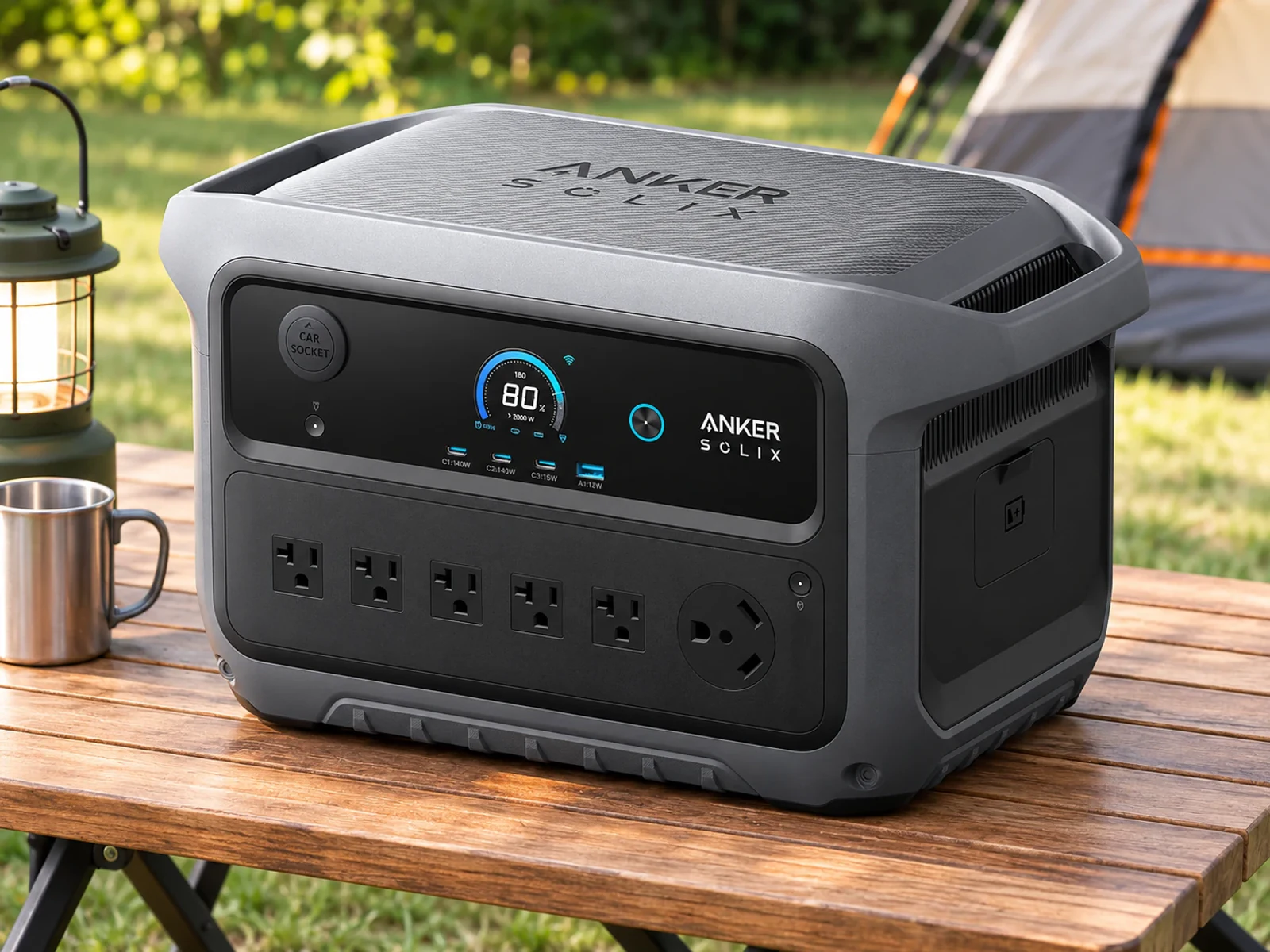 Anker SOLIX Anker SOLIX C2000 Gen 2 | 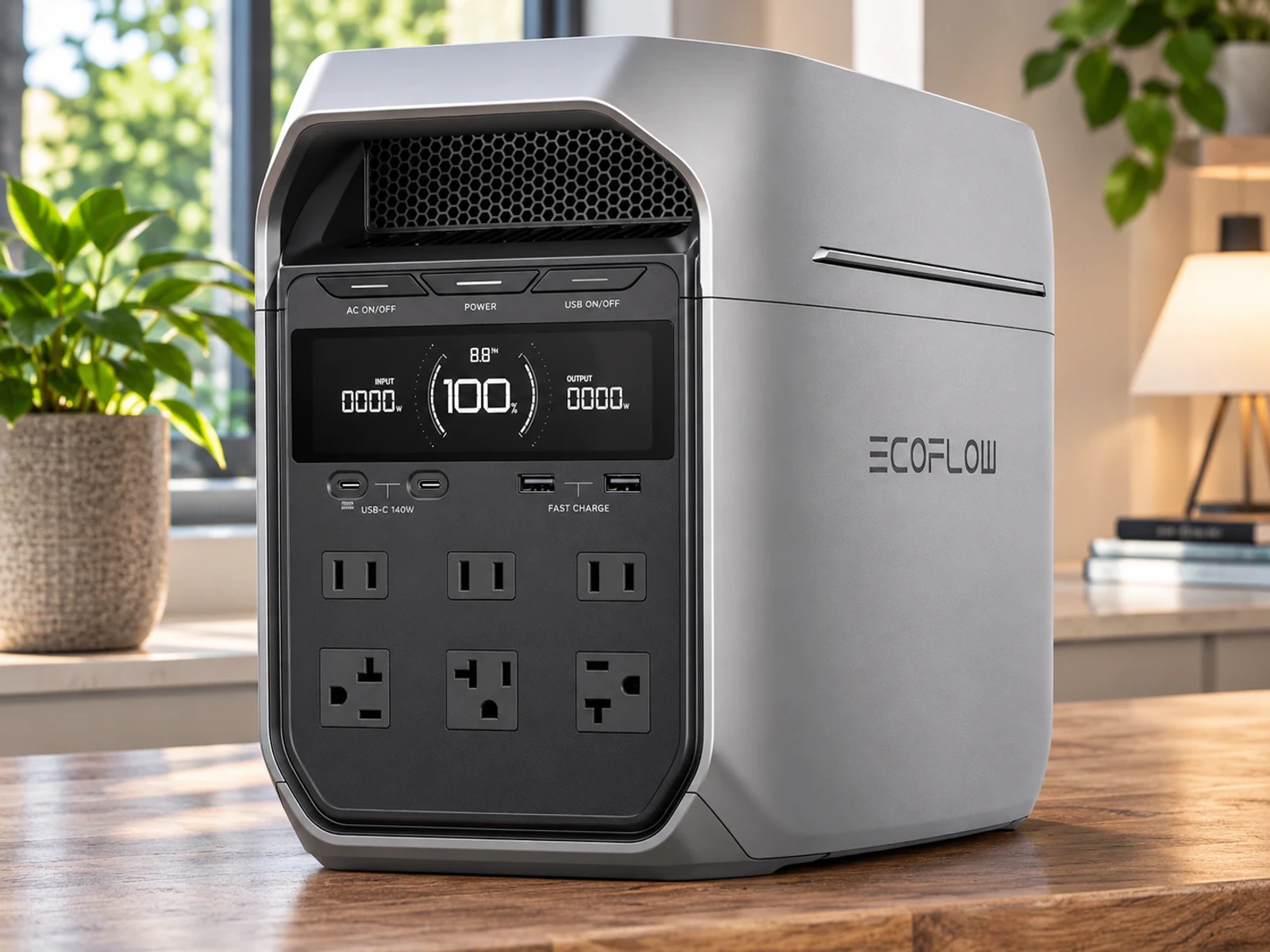 EcoFlow EcoFlow DELTA 3 Plus | 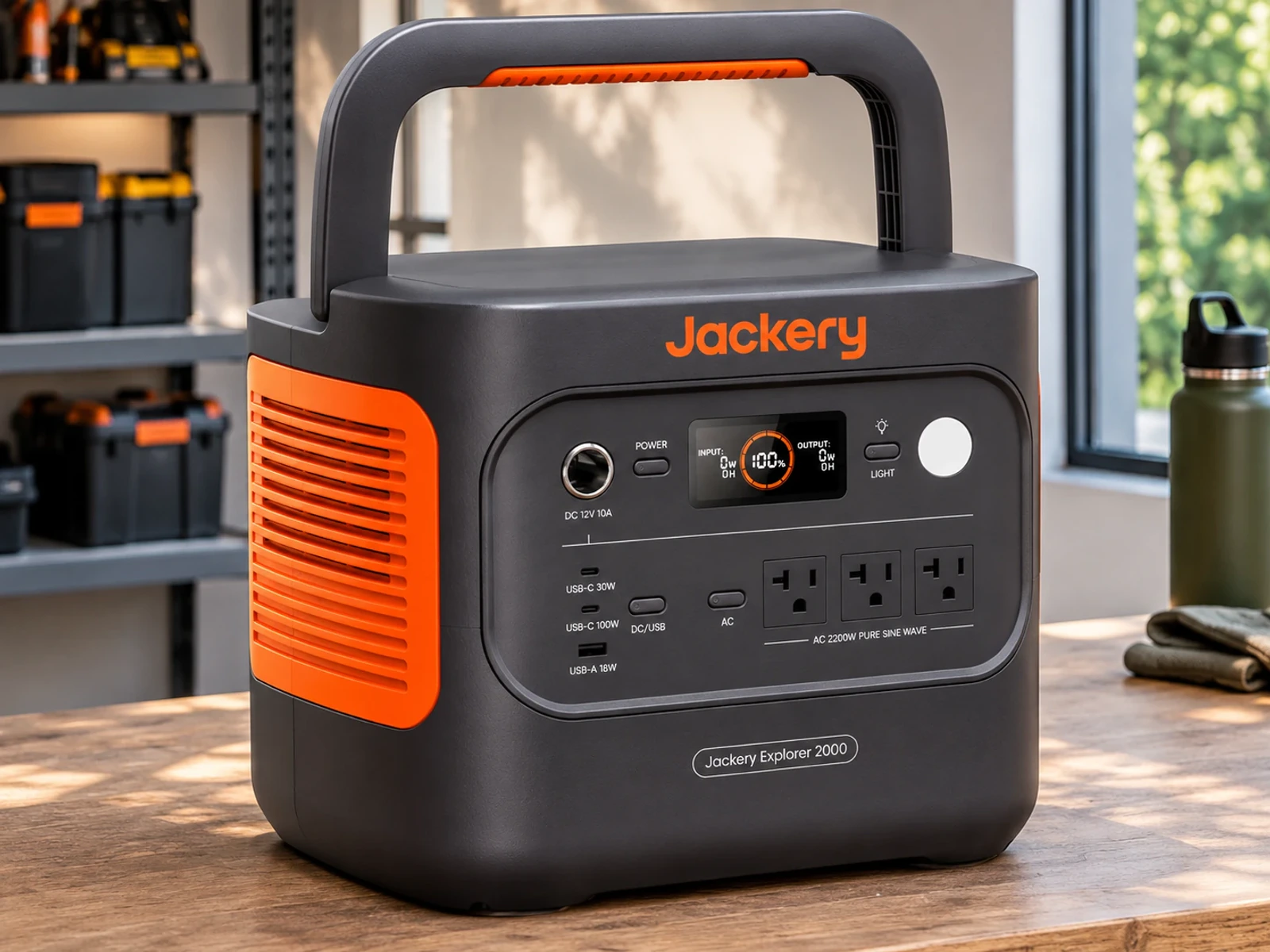 Jackery Jackery Explorer 2000 v2 |
|---|---|---|---|
| Battery capacity | 2,048 WhMaker’s noteUser guide: the discharge lower limit can be set from 1% to 20% in the Anker app, which reduces usable energy. | 1,024 Wh | 2,042 Wh |
| AC output (rated) | 2,400 WBest | 1,800 W | 2,200 W |
| Peak / boost output | 4,000 WMaker’s noteStated as "Peak Power 4000W". The user guide does not define this figure. It describes SurgePad, which supplies up to 3,000W when total output exceeds the rated output, works better with devices that generate heat, and does not work in bypass mode. The 2,400W rated output is the continuous figure. | 3,600 WMaker’s noteStated as surge 3600W. X-Boost (for compatible resistive devices) is stated separately as 2200W. | 4,400 WMaker’s noteStated as 4400W surge peak. |
| Switchover time (stated) | 10 msMaker’s noteListed as "UPS 10 ms". User guide: switches to battery within 10ms. In bypass mode (grid power passing through while charging), AC input/output is 1,800W max. | 10 msMaker’s noteStated as <10ms. | 20 msMaker’s noteStated as <20ms. Manual: switches to battery within 20ms and "does not support 0ms switching"; Jackery advises testing several times to confirm compatibility and connecting only one device. In UPS mode, peak output reaches 1,500W. The 2,200W rated output applies during outages. |
| Expandable battery | YesBest | YesBest | NoMaker’s noteJackery FAQ: "No, the Explorer 2000 v2 is not expandable." |
| Max capacity with expansion | 4,000 WhMaker’s noteStated as "up to 4kWh" with the BP2000 Gen 2 battery (2,048 Wh). | 5,000 WhMaker’s noteStated as "up to 5kWh" with DELTA 3, DELTA 2, DELTA 2 Max, or DELTA Pro 3 Extra Batteries. | Not expandable |
| Max solar input | 800 WMaker’s notePV / XT-60i input, 11V to 60V, 17A max, 800W. | 1,000 WBestMaker’s noteTwo solar ports, 500W max each (11V to 60V). | 400 WMaker’s noteTwo DC 8mm ports, stated as "Double to 21A/400W Max". |
| Weight | 41.7 lbMaker’s noteStated as 41.7 lb (18.9 kg). | 27.6 lbBestMaker’s noteStated as approx. 12.5 kg (27.6 lb). | 39.5 lbMaker’s noteStated as around 39.5 lbs (17.9 kg). |
Manufacturer-stated specifications. “Best” marks a lead of at least 5%, and only when every product above states the value. Peak ratings, cycle life, and switchover times are not ranked because brands state them differently.
Our picks in detail
1. Best overall for a full day of fridge backup
Anker SOLIX C2000 Gen 2
EditorialAt 2,048 Wh it has the capacity for about a full day with a typical 500 kWh/yr refrigerator: about 30 hours by our calculation, or about 27 hours once Anker's stated 9 W idle consumption is counted. It has the highest rated output of our picks at 2,400 W. Anker also states expansion up to 4 kWh, up to 800 W of solar input, and an 800 W alternator charging option, so you can refill during a long outage.
- Battery capacity
- 2,048 Wh
- AC output (rated)
- 2,400 W
- Weight
- 41.7 lb
- +UPS switchover stated at 10 ms, versus under 20 ms for the Explorer 2000 v2
- +800W solar and 800W alternator charging
- +Expandable to 4 kWh
- −Warranty length not stated on the product page
- −41.7 lb
- −Number of standard AC outlets not stated
- Who should consider it
- Households that want a typical full-size fridge covered through a full day, with the option to add a battery or recharge from solar.
- When another option fits better
- If you will never add a battery, the Explorer 2000 v2 offers similar capacity at 39.5 lb.
2. Best for overnight outages
EcoFlow DELTA 3 Plus
Editorial1,024 Wh covers a typical 500 kWh/yr refrigerator for about 15 hours by our calculation, enough for an overnight outage. Its manual states pure sine wave AC output at 1,800 W total with a 3,600 W surge, a standby UPS transfer time of 10 ms, and expansion up to 5 kWh with extra batteries.
- Battery capacity
- 1,024 Wh
- AC output (rated)
- 1,800 W
- Weight
- 27.6 lb
- +1,800W across six AC outlets
- +1,000W of solar input over two ports
- +Expandable to 5 kWh (stated)
- −27.6 lb, so a two-hand carry
- −Peak and X-Boost ratings are separate figures; check which applies to your device
- Who should consider it
- Households that mostly see overnight or half-day outages, or that want to start smaller and add a battery later.
- When another option fits better
- If outages where you live often last a full day or longer, start with a 2 kWh unit such as the SOLIX C2000 Gen 2.
3. Best 2 kWh option without add-on batteries
Jackery Explorer 2000 v2
Editorial2,042 Wh gives about 30 hours with a typical 500 kWh/yr refrigerator by our calculation, before idle draw, which Jackery does not state. Its manual lists 2,200 W rated output with a 4,400 W surge peak and a switch to battery within 20 ms. It is not expandable, so the capacity you buy is the capacity you have.
- Battery capacity
- 2,042 Wh
- AC output (rated)
- 2,200 W
- Weight
- 39.5 lb
- +2,042 Wh at 39.5 lb, the lightest 2 kWh unit here
- +2,200W rated output
- +UPS switching stated under 20 ms
- −Not expandable (per Jackery FAQ)
- −Solar input stated as 400W max
- −Three AC outlets
- Who should consider it
- Households that want about a full day of fridge backup in a single unit and do not plan to add batteries.
- When another option fits better
- If you want faster solar recharging or room to expand, the SOLIX C2000 Gen 2 states 800 W solar input and expansion to 4 kWh.
Set up the power station for a refrigerator
A refrigerator is an intermittent load: it draws more while the compressor runs and very little in between. Some power stations treat a small load as idle and switch off. Check these settings before an outage:
- EcoFlow DELTA 3 Plus: the manual warns that AC timeout may switch off output with an intermittent load such as a refrigerator. For continuous use, set the AC timeout to "never" in the EcoFlow app.
- Jackery Explorer 2000 v2: Energy Saving Mode is on by default and turns off all outputs after 12 hours when the AC load stays at 25 W or less. To turn it off, long-press the AC button and the main power button until the icon disappears.
- Anker SOLIX C2000 Gen 2: the user guide lists a default standby duration of 12 hours, adjustable in the Anker app. Check how it applies with a refrigerator connected.
If you leave the refrigerator plugged into the power station while it charges from the wall, the station passes grid power through and switches to battery when the grid drops. Each maker states limits for that mode: Jackery's UPS mode peaks at 1,500 W and Jackery recommends connecting only one device, and Anker lists bypass output at 1,800 W max with SurgePad unavailable. Read the manual before relying on it day to day.
Running a refrigerator and a freezer
Add the two EnergyGuide figures together and run the same math. A 500 kWh/yr refrigerator plus a 300 kWh/yr freezer comes to about 2,190 Wh a day, or about 91 W on average. By our calculation that is roughly 19 hours on a 2 kWh station and about 9.5 hours on the 1 kWh DELTA 3 Plus, before idle draw.
Both compressors may start at the same moment, so check that the station's rated output covers both running loads and its surge covers both startups. Running each on its own station is another option. A full freezer holds its temperature for about 48 hours with the door closed (about 24 hours if half full), so plan your capacity around your actual combined use.
Keep food cold for longer
The 4-hour figure in food-safety guidance describes how long a closed refrigerator keeps food safe with no power at all. It is not a schedule for switching the refrigerator off and on, and we do not recommend unplugging it to stretch your battery. Instead:
- Keep the doors closed. Every opening lets cold air out and makes the compressor run longer.
- Monitor the temperature. Keep an appliance thermometer in the refrigerator and the freezer.
- Hold safe temperatures. USDA advises 40°F or below in the refrigerator and 0°F or below in the freezer.
- Recharge when you can. All three picks accept solar input. Real solar output depends on weather, shade, and panel angle, so treat the stated maximum as a ceiling.
- Plan from real consumption. Measure your refrigerator's actual daily use and size capacity, plus recharging, to the outage length you expect.
If you cannot keep the refrigerator powered, USDA suggests moving food to a cooler with ice or frozen gel packs to keep it at 40°F or below.
Food safety during a power outage
Backup power can keep a refrigerator cold, but the official guidance still applies, and it has two parts.
If the refrigerator loses power:
- A closed refrigerator keeps food safe for up to about 4 hours. A full freezer holds its temperature for about 48 hours, or about 24 hours if half full (FoodSafety.gov, USDA).
- After an outage longer than 4 hours, check each item separately and throw away refrigerated food such as meat, poultry, fish, eggs, and milk. FoodSafety.gov's charts cover many more foods.
- Thawed frozen food can be safely refrozen if it still contains ice crystals or is at 40°F or below, though quality may suffer.
Whether or not you have backup power:
- Use appliance thermometers. The refrigerator should stay at 40°F or below and the freezer at 0°F or below. A working thermometer tells you more than the clock does.
- When in doubt, throw it out. Discard food with an unusual odor, color, or texture, or that feels warm, and never taste food to decide whether it is safe.
- If someone relies on refrigerated medicine, plan for it with a pharmacist or doctor before an outage (Ready.gov).
Size it for your own refrigerator
Size it before you buy
Three numbers decide which unit fits
1
List what must stay on
Add each device and how many hours a day you need it. Watts × hours gives the energy you need, in watt-hours (Wh).
2
Check what runs at once
Add up the watts of everything running at the same time. The unit's rated (continuous) output in watts (W) must be higher.
3
Flag startup loads
Fridges, freezers, pumps, and AC draw extra power for a moment when they start. Check that against the maker's surge rating.
The power calculator does this math, adds about 15% inverter loss, and lists the units in our catalog whose stated capacity and rated output meet your estimate.
Questions
How long will a 1,000 Wh power station run a refrigerator?
For a typical 500 kWh/yr full-size refrigerator, about 15 hours by our calculation (1,000 Wh × 0.85 ÷ 57 W ≈ 14.9 hours). Idle draw, battery reserve, and real conditions usually make it shorter.
How long will a 2,000 Wh power station run a refrigerator?
About 30 hours for the same refrigerator, before idle draw (2,000 Wh × 0.85 ÷ 57 W ≈ 29.8 hours). With Anker's stated 9 W idle consumption, the SOLIX C2000 Gen 2 estimate is about 27 hours.
What size power station do I need for a refrigerator?
Size it from your outage length. Take your fridge's daily energy use (kWh per year × 1,000 ÷ 365, or a measured figure), multiply by the number of days you want to cover, and divide by 0.85. A typical 500 kWh/yr fridge needs about 1,610 Wh of battery for one day, before idle draw and reserve. Then confirm the station's rated output and surge suit your fridge, and test it.
Can a portable power station start a refrigerator compressor?
It can, if its rated and surge output suit that refrigerator, but no surge rating guarantees it. Check your fridge's requirements, watch for surge figures tied to special modes, and test with your own refrigerator before an outage.
Do I need pure sine wave output for a refrigerator?
Follow your refrigerator manual's guidance on inverter or generator power. Of our picks, EcoFlow's manual states pure sine wave output for the DELTA 3 Plus. The Anker and Jackery documents we read do not state the waveform in their text.
Is a power station safe to use indoors?
Battery power stations do not burn fuel, so they do not produce carbon monoxide the way a fuel generator does. Follow the manufacturer's manual for placement, ventilation, and temperature limits. Our hurricane power station guide covers outage safety in more detail.
How we chose
We compared manufacturer-published specifications and manuals for the portable power stations in our catalog that have an owner-approved retailer listing, then matched them to the two refrigerator checks: enough stored energy for an overnight or full-day outage, and rated and surge output suited to a compressor start. We left out units under 300 Wh, which would run a typical fridge for only about 4 hours by our calculation. We also left out 1 kWh units whose only figure above rated output is a boost mode their makers do not present as a motor-startup rating, and a larger unit that does not state a surge figure at all. Runtimes are our calculations from stated capacity and EnergyGuide figures. We have not tested these units with a refrigerator. Read more in our editorial standards.
For a broader outage plan, including CPAPs and medical devices, see our hurricane power station guide and Prepping 101. You can also compare the two 2 kWh picks in our Explorer 2000 v2 vs SOLIX C2000 Gen 2 comparison.
Your next step
Best overall for a full day of fridge backup
Anker SOLIX C2000 Gen 2Best for overnight outages
EcoFlow DELTA 3 PlusBest 2 kWh option without add-on batteries
Jackery Explorer 2000 v2
SemperPrep may earn a commission when you buy through links on this site. It costs you nothing extra. As an Amazon Associate, I earn from qualifying purchases. How we make money